Prompt Chaining in n8n for Smarter AI Automation Guide
Sasha Ray
28th Aug, 2026
Prompt Chaining in n8n: Build Smarter AI Automation Workflows
Artificial Intelligence has changed how businesses automate repetitive tasks, but the quality of AI output depends on how prompts are designed and executed. Instead of sending one large prompt to a language model, developers now use n8n to divide complex tasks into smaller, connected steps. This approach improves accuracy, makes workflows easier to maintain, and reduces errors.
Whether you're building AI-powered customer support, document processing, content generation, or data analysis, Prompt Chaining in n8n provides a structured way to create intelligent workflows that are scalable and reliable.
What is Prompt Chaining?
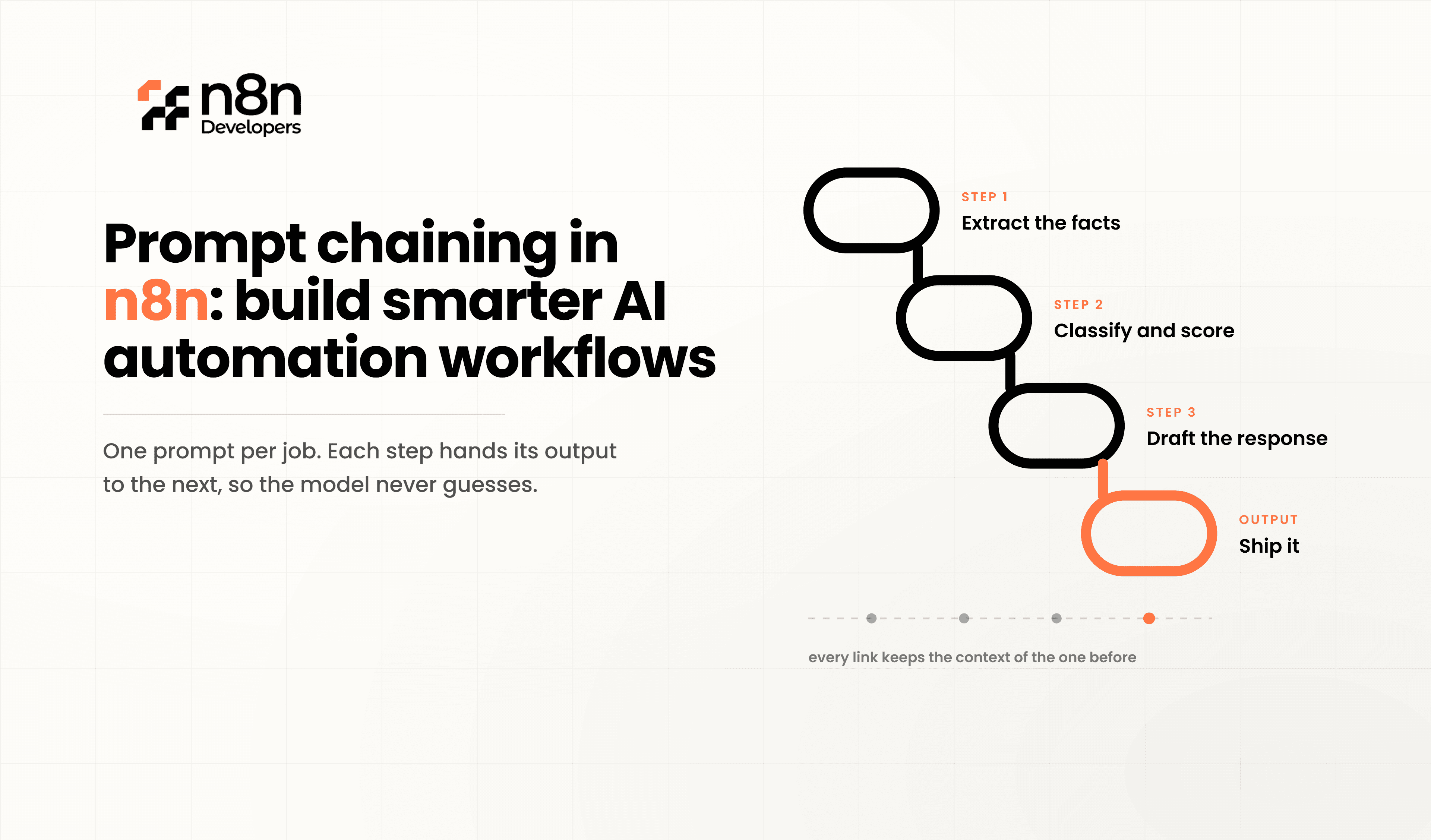
Prompt chaining is the process of connecting multiple AI prompts together so that the output from one prompt becomes the input for the next. Rather than asking an AI model to complete everything in a single request, each prompt performs a specific task.
For example:
Read customer email
Identify the intent
Extract important details
Generate an appropriate response
Review the response for quality
Send the final email
Each step has one responsibility, making the workflow more accurate and easier to troubleshoot.
Why Use Prompt Chaining?
A single prompt can become lengthy and difficult to maintain. Large prompts may also produce inconsistent results.
Prompt chaining solves these challenges by:
Improving response accuracy
Simplifying debugging
Making workflows reusable
Reducing hallucinations
Allowing independent testing of each step
Supporting enterprise-scale AI automation
This modular approach is widely used in modern AI applications.
How Prompt Chaining Works
A typical workflow follows these stages:
Step 1: Receive Input
Data can come from:
Webhooks
Forms
CRM systems
Databases
APIs
Emails
The workflow begins whenever new information arrives.
Step 2: Clean the Data
Before sending information to an AI model, remove unnecessary formatting, validate fields, and normalize the input.
Example tasks include:
Removing HTML
Fixing spacing
Converting dates
Filtering unwanted text
Clean input leads to better AI responses.
Step 3: First AI Prompt
The first prompt usually identifies or classifies information.
Example:
"Determine whether this email is a sales inquiry, support request, or billing issue."
The output becomes structured data.
Step 4: Second AI Prompt
Using the classification result, the workflow requests more detailed information.
Example:
"Extract the customer's product name, issue, urgency level, and requested action."
Now the workflow contains organized business data instead of plain text.
Step 5: Third AI Prompt
The next prompt generates meaningful content.
Examples include:
Email replies
Blog outlines
Reports
Product descriptions
Meeting summaries
Because earlier prompts already prepared the information, this response is usually more accurate.
Step 6: Validation
Before publishing or sending results, validate the AI response.
Checks may include:
Missing fields
Invalid formatting
Required keywords
Character limits
Business rules
If validation fails, the workflow can retry or request another AI response.
Example Business Use Cases
Customer Support
Prompt chain:
Detect language
Identify problem
Retrieve documentation
Generate response
Check grammar
Send reply
Content Marketing
Workflow steps:
Research topic
Create outline
Write introduction
Expand sections
Optimize SEO
Generate meta description
Publish
This approach improves consistency across content.
Invoice Processing
Steps include:
Read invoice
Extract totals
Verify vendor
Match purchase order
Create accounting entry
Prompt chaining reduces manual review.
Lead Qualification
Businesses can automate:
Read enquiry
Identify company
Estimate budget
Calculate lead score
Route sales opportunity
Sales teams receive higher-quality leads automatically.
Best Practices for Prompt Chaining
Keep Prompts Focused
Every prompt should solve only one problem.
Instead of:
Analyze, summarize, classify, and generate an email.
Split into separate prompts.
Store Structured Data
Use JSON whenever possible.
Example:
{
"customer":"John",
"priority":"High",
"issue":"Payment failed"
}
Structured outputs make later workflow steps much simpler.
Handle Errors
Always prepare for:
API failures
Timeout errors
Empty responses
Invalid JSON
Missing variables
Adding retry logic improves workflow reliability.
Monitor Token Usage
Large prompts increase AI costs.
Break workflows into smaller requests so only necessary information is sent to the model.
Reuse Components
Many prompt chains can be reused across projects.
Examples include:
Translation
Sentiment analysis
Text summarization
Data extraction
Reusable workflows save development time.
Advanced Prompt Chaining Techniques
Developers can extend prompt chaining with:
Conditional branching
Memory storage
Vector databases
RAG (Retrieval-Augmented Generation)
Human approval steps
Multi-model AI routing
API integrations
These techniques create enterprise-ready AI solutions.
Benefits for Organizations
Businesses adopting prompt chaining experience:
Faster automation
Better AI accuracy
Easier maintenance
Lower operational costs
Consistent outputs
Improved customer experiences
Faster software delivery
These benefits make prompt chaining valuable across many industries.
Why Businesses Choose Professional Automation Experts
Building reliable AI workflows requires more than connecting nodes. Proper workflow architecture, security, API integration, monitoring, and optimization all play a major role in long-term success.
N8n Developers helps organizations design scalable automation solutions using modern AI technologies. We provide Information technologies and developers to build secure, efficient, and business-ready workflow automation tailored to enterprise requirements.
Prompt Chaining in n8n is one of the most effective methods for creating intelligent AI automation. Instead of relying on a single complex prompt, developers divide tasks into smaller connected stages that improve accuracy, reliability, and scalability. As organizations continue adopting AI, structured prompt chaining will become an essential practice for building maintainable automation systems.
Common Mistakes to Avoid
Overloading a single node
— if a prompt is trying to extract, analyze, and generate all at once, split it
Ignoring error handling
— a broken chain link without fallback logic can silently corrupt your entire workflow
Skipping validation
— always add a check before AI-generated content reaches a live system or customer
Hardcoding prompts
— use n8n variables and templates so your chain can adapt to different inputs
Prompt chaining in n8n turns unpredictable, single-shot AI prompts into structured, reliable workflows you can actually trust in production. By breaking tasks into smaller steps, connecting them visually in n8n, and adding validation along the way, developers can build automations that are accurate, debuggable, and easy to scale.
If you're ready to move beyond one-off prompts and build real AI-powered automation, now is the time to start chaining.
Whether you're automating customer support, content creation, document processing, or business operations, implementing n8n prompt chaining helps deliver better AI results while simplifying workflow management. By following best practices, validating outputs, and designing modular workflows, businesses can build automation that is efficient today and ready for future growth.
Frequently Asked Questions
Prompt chaining connects multiple AI prompts into a structured workflow for better results.
It improves AI accuracy, simplifies maintenance, and reduces workflow errors.
Yes, it works with most LLMs that support API-based prompt execution.
Yes, it is ideal for scalable, secure, and maintainable enterprise AI workflows.
Customer service, healthcare, finance, marketing, logistics, and IT all benefit from prompt chaining.