n8n vs Workato vs Tray.ai: Enterprise iPaaS Compared
Sasha Ray
24th Sep, 2026
n8n vs Workato vs Tray.ai
Three platforms, three different theories of what enterprise integration should be. Workato believes business users should build with guardrails. Tray.ai believes integration engineers should have maximum control, including the ability to embed integrations inside their own product. n8n believes you should be able to run the whole thing on your own infrastructure for the price of a server.
n8n vs Workato vs Tray.ai is rarely a feature comparison in practice. It is a decision about who builds, where the data lives, and what your organisation can sign. This guide covers each honestly — including where n8n loses, because a comparison that concludes the author's preferred tool wins everything is not worth reading. We build on n8n, and we will tell you plainly when it is the wrong answer. Organisations that land on n8n after this evaluation often Hire n8n Developers for implementation, because the platform's lower licence cost assumes engineering capability the others sell as a service.
Start With the Three Disqualifying Questions
Most evaluations run for weeks and end where they would have ended in twenty minutes. Answer these first:
Must the data stay on your infrastructure? If yes, n8n is the only one of the three you can self-host. Workato and Tray.ai are cloud platforms — Workato offers an on-premise agent for reaching systems behind your firewall, but the platform itself runs in their cloud.
Are you embedding integrations into a product you sell? If yes, Tray.ai leads. Embedded iPaaS — white-labelling the integration engine so your own customers get integrations inside your product — is where it is genuinely strongest, and neither n8n nor Workato has an equivalent offering.
Will business users build, or will engineers? Workato is built for business technologists building with governance rails. n8n is built for people comfortable with APIs and data structures. Getting this wrong is the most expensive mistake in the evaluation, because it produces a platform nobody uses.
If none of these settles it, the comparison below is worth your time.
Workato
Where it wins
Connector depth is the real argument, and it is a strong one. Workato's library runs to roughly 1,200 connectors, with deep object coverage on the enterprise systems that matter — SAP, Oracle, Workday, NetSuite, Salesforce. The gap between "has a connector" and "has a connector that exposes the object you need" is where integration projects die, and Workato closes it more often than the alternatives.
Its community marketplace holds an enormous library of pre-built recipes, which meaningfully shortens time to first working integration.
Governance is mature. Recipe Lifecycle Management gives you proper dev, test, and production environments with promotion between them — the thing IT teams ask about in the second meeting and which many platforms answer poorly.
And the recipe model genuinely does let business technologists build. That is not marketing; it is the product's central design decision and it works.
Where it loses
Cost, and the shape of the cost. Workato is sales-led with no public pricing, and reported entry points vary widely — figures between $10,000 and $25,000 a year appear across sources, with mid-market deals often reported considerably higher once recipe packs are added. Treat any specific number you read, including these, as indicative only.
Renewal increases are a recurring theme in enterprise peer reviews. Model your three-year cost, not your first-year cost.
You cannot self-host, which rules it out for some regulated and sovereignty-constrained deployments regardless of its merits.
Tray.ai
Where it wins
Embedded integration is the standout. If you are a SaaS company that needs to offer your customers integrations with their tools, Tray.ai is built for that use case in a way the others are not. This alone decides the evaluation for a certain kind of buyer.
The visual builder gives granular control over loops, conditional logic, and raw API calls, and technical teams consistently rate it as more flexible than Workato's recipe model. What you see on the canvas is what executes.
Merlin Agent Builder gives it a current AI agent story rather than a roadmap promise.
Where it loses
The ecosystem is smaller than Workato's — fewer connectors, a less extensive template library, and fewer implementation partners.
Pricing is also sales-led, and published figures conflict badly. Some aggregators list monthly tiers in the low hundreds; others report enterprise contracts from a few thousand to twenty thousand plus per year. That range is too wide to plan against, which means you will be in a sales process before you know whether it fits your budget.
Like Workato, it is cloud-only.
n8n
Where it wins
Cost is not a marginal difference, it is an order of magnitude. Cloud plans are self-serve and priced in tens of euros per month at entry tiers, billed per workflow execution rather than per task or step — one complete run counts once regardless of how many nodes it contains. The self-hosted Community Edition has no licence fee at all.
Self-hosting is the decisive capability for regulated deployments. Source-available under a fair-code licence, running on your own infrastructure, with your data never leaving it.
It is the most AI-native of the three. Agents, tool calling, vector stores, and model nodes are first-class rather than bolted on, and AI workflows consume ordinary executions rather than a premium AI tier.
No lock-in. Workflows are JSON you can read, version in Git, and take with you.
And it is self-serve. You can evaluate it properly this afternoon without a sales call.
Where it loses
Say this part honestly.
Connector depth on enterprise systems is genuinely weaker. n8n has broad integration coverage, but for SAP, Workday, or Oracle you will often be building against REST APIs with the HTTP Request node rather than using a connector that already knows the object model. That is engineering work Workato has already done for you, and pretending otherwise wastes everyone's time.
Governance sits behind paid tiers. SSO, advanced RBAC, log streaming, Git-based environments, and external secret stores are Business and Enterprise features. The free Community Edition has none of them, and buyers routinely conflate "n8n is free" with "n8n Enterprise is free."
The zero licence cost hides real cost. Self-hosting means you own uptime, upgrades, scaling, backups, and security patching. n8n itself recommends its cloud plans for teams without the expertise to run a production instance. Budget engineering time or managed hosting, then compare.
No embedded iPaaS offering. If that is your use case, n8n is not the answer.
Smaller partner ecosystem. Fewer certified implementation partners than Workato, which matters to procurement teams who want a named integrator on the contract.
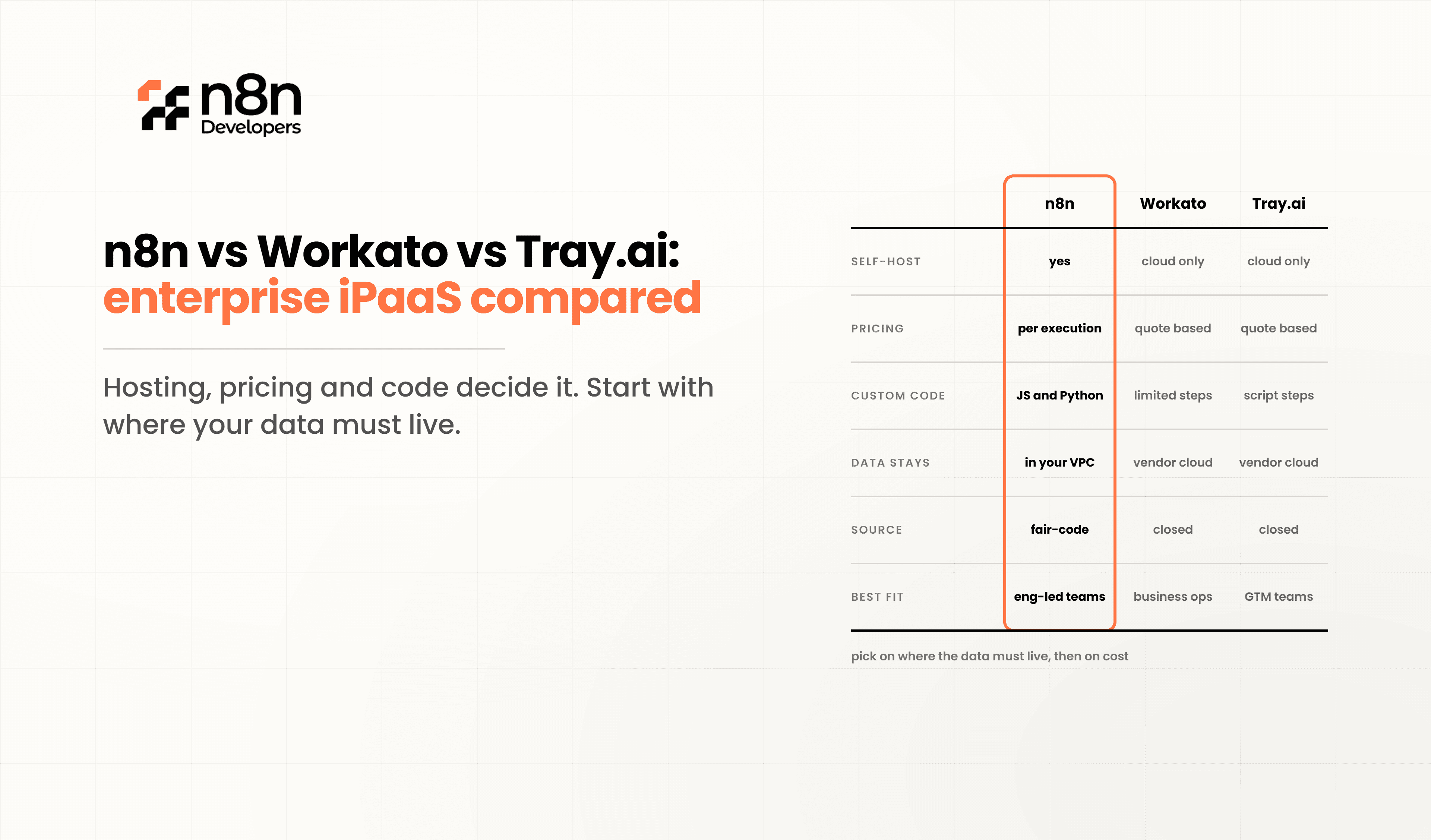
Side-by-Side Comparison
n8n | Workato | Tray.ai | |
Self-hosting | Yes | No (on-prem agent only) | No |
Licence | Fair-code, source-available | Proprietary | Proprietary |
Pricing transparency | Public, self-serve | Sales-led, no public pricing | Sales-led, conflicting reports |
Pricing unit | Per workflow execution | Per task / recipe | Per workflow / usage |
Entry cost | Tens of euros per month | Reported five figures annually |
Total Cost of Ownership, Honestly
The licence comparison flatters n8n and the implementation comparison does not, so compare both.
A Workato deployment costs substantially more in licensing and substantially less in engineering. Business users build, connectors already exist, environments and governance come configured. You are buying time.
An n8n deployment costs almost nothing in licensing and requires real engineering. Someone builds the integrations, someone configures the error handling, someone runs the infrastructure or pays for managed hosting. You are buying control and flexibility.
For an organisation with engineering capacity, n8n is dramatically cheaper across three years. For one without, the difference narrows considerably and can invert — an unused platform costs more than an expensive one that works.
The honest heuristic: if you would need to hire or contract for n8n implementation and the savings still exceed that cost, n8n wins on TCO. If the savings roughly match the implementation cost, buy the platform your team will actually use.
Real Buyer Scenarios
Regulated Enterprise with Data Residency Requirements
Self-hosting is mandatory, which leaves n8n. Budget for Enterprise tier governance and proper infrastructure — the Community Edition will not satisfy an audit.
Mid-Market Company with SAP or Workday at the Centre
Workato, most likely. The connector depth is real and rebuilding it against raw APIs is a project, not a task.
SaaS Company Offering Customer-Facing Integrations
Tray.ai. Embedded iPaaS is the use case it is built for.
Engineering-Led Organisation Automating Internal Operations
n8n. Your team is the capability the other platforms are selling you, and you are paying for it twice if you buy them.
AI-Heavy Automation Programme
n8n, usually. Agents and model integration are native, AI runs consume ordinary executions rather than premium AI pricing, and you pay model providers directly.
Business-User-Led Automation with IT Governance
Workato. This is precisely what the recipe model and lifecycle management exist for, and n8n will frustrate non-technical builders within a month.
Why Platform Choice Is Less Decisive Than Implementation
A well-implemented deployment on the cheaper platform beats a poorly implemented one on the expensive platform every time. Most failed integration programmes fail on error handling, ownership, documentation, and governance — none of which any vendor supplies for you.
At this stage, organisations that have chosen n8n commonly Hire n8n Developers to build the foundation the licence fee does not include: instance architecture, credential and access design, error handling and alerting, reusable components, and the difficult integrations where no connector exists.
Best Practices for Evaluating iPaaS
Follow these to avoid a decision you regret at renewal:
Answer the three disqualifying questions before booking any demos.
Build the same real integration on each shortlisted platform, not a vendor-chosen demo.
Pick your hardest integration for that test, not your easiest.
Model three-year cost including renewal increases and implementation.
Ask each vendor for the object coverage on your specific critical systems, not the connector count.
Confirm governance features are in the tier you can afford, not just on the feature page.
Test the error handling and alerting story explicitly.
Ask what exporting your workflows looks like on the day you leave.
Include the cost of the team you will need, not only the platform.
Get compliance and procurement requirements documented before the evaluation, not after.
The export question is worth asking early. The answers vary enormously and tell you a great deal about how the relationship will feel in year three.
Scaling on Any of These Platforms
Whichever you choose, the same disciplines determine whether it holds up:
Separate development, staging, and production environments
Version control on workflow definitions
Centralised error handling with alerting that reaches a human
Named ownership for every integration
Documented data flows for audit
Monitoring on failure rate and execution volume
A review process before anything reaches production
Workato and Tray.ai supply more of this out of the box. On n8n, more of it is yours to build — which is both the cost and the point.
Why Choose N8n Developers?
N8n Developers specialises in n8n implementation for organisations that have chosen it deliberately — usually for data residency, cost, or AI capability. We build the parts the licence does not cover: self-hosted architecture, credential and access design, error handling and observability, reusable integration components, and the enterprise API work where no connector exists. We also say when n8n is the wrong fit; if your requirement is deep Workday object coverage with business users building, we will tell you that rather than quote for it. Whether you need a migration from an existing iPaaS, a greenfield implementation, or ongoing support, we build for the long term.
Future of the iPaaS Market
The category is consolidating around AI agents, and all three are moving there — Workato through recipe-integrated AI and MCP tooling, Tray.ai through Merlin, n8n through native agent nodes. The differentiator will not be whether a platform has agents but whether it can run them against your systems, under your governance, at a cost that survives scale.
The other shift is pricing pressure. Execution-based and self-hostable models are making per-task enterprise pricing harder to defend, particularly for AI workloads where a single run may involve many steps. Expect the gap to narrow from the top.
Organisations planning multi-year automation programmes frequently Hire n8n Developers to build on an architecture that will not need replacing when the market moves again.
If you are evaluating iPaaS platforms, or you have chosen n8n and need it implemented properly, our team can help. Hire n8n Developers today for an honest assessment of whether n8n fits your requirements, and a plan if it does.
Deciding between n8n vs Workato vs Tray.ai comes down to three things and rarely more. If data must stay on your infrastructure, n8n is the only option of the three. If you are embedding integrations into a product you sell, Tray.ai. If business users will build against deep SAP, Oracle, or Workday object models with governance rails, Workato, and the cost is what it is. Everything else — connector counts, AI roadmaps, canvas aesthetics — moves the decision far less than teams expect. Build your hardest integration on the shortlist before you sign anything, and model the cost of the team as carefully as the cost of the licence.
Frequently Asked Questions
For engineering-led teams, yes, at a fraction of the cost. For business-user-led automation on deep enterprise systems like SAP or Workday, Workato's connector depth and governance are genuinely ahead.
No. Workato offers an on-premise agent for reaching systems behind your firewall, but both platforms run in the vendor's cloud. n8n is the only self-hostable option of the three.
n8n publishes self-serve pricing from tens of euros per month. Workato and Tray.ai are sales-led with no public pricing, and reported figures vary too widely to plan against without a quote.
n8n is the most AI-native, with agents as first-class nodes and no premium AI tier. Workato and Tray.ai both have AI offerings but bundle them into their existing commercial models.
Tray.ai. Embedded iPaaS is its strongest differentiator, and neither n8n nor Workato offers a comparable white-label option.
n8n's low licence cost assumes engineering capability. Implementation partners supply the architecture, governance, and integration work the other platforms charge for in the licence.