Multi-Tenant n8n Architecture: A Complete Developer's Guide
Sasha Ray
5th Oct, 2026
Multi-Tenant n8n Architecture: A Complete Developer's Guide
If you're building a SaaS product that needs to run automated workflows for hundreds — or thousands — of customers, a **n8n** is one of the smartest technical decisions you can make. Instead of spinning up a separate instance for every client, a well-designed multi-tenant setup lets you serve multiple customers from a single, shared n8n environment while keeping their data, credentials, and workflows completely isolated.
In this blog, we'll break down what multi-tenancy means in the context of n8n, why it matters, the architecture patterns you can use, and how to implement it the right way.
What Is Multi-Tenant n8n Architecture?
A Multi-Tenant n8n Architecture is a system design where a single n8n installation (or cluster) serves multiple independent "tenants" — these could be different clients, business units, or customer accounts. Each tenant operates as if they have their own private automation platform, but behind the scenes, they share the same infrastructure, database, and compute resources.
This approach is common in SaaS platforms that offer workflow automation as a feature, internal agencies managing automations for multiple clients, and platforms that white-label n8n for end users.
Why Choose a Multi-Tenant Setup?
Cost Efficiency
– Running one shared instance is far cheaper than maintaining separate servers for every client.
Easier Maintenance
– Updates, patches, and monitoring happen in one place instead of across dozens of environments.
Faster Onboarding
– New tenants can be provisioned in minutes instead of hours.
Centralized Monitoring
– You get a single dashboard to track performance, errors, and usage across all tenants.
However, multi-tenancy also introduces challenges around data isolation, security, resource allocation, and scaling — which is why proper architecture planning is essential.
Core Components of a Multi-Tenant n8n Architecture
Tenant Isolation Strategy
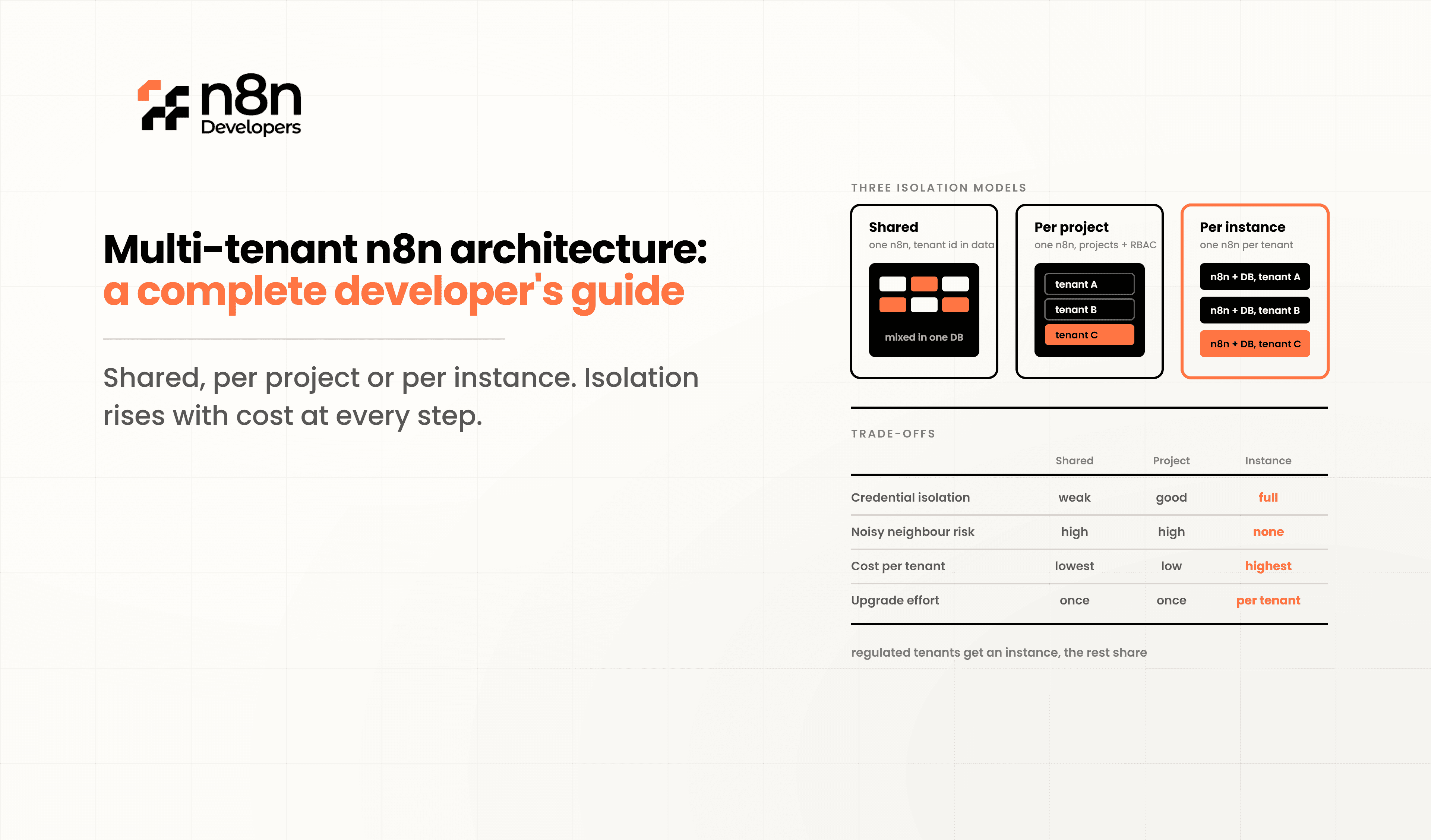
There are three common isolation models:
Database-per-tenant
– Each tenant gets a separate database schema, offering the strongest isolation.
Shared database with tenant IDs
– All tenants share one database, but every table includes a tenant_id column to segregate data logically.
Workflow-level isolation
– Using n8n's folder/project structure combined with role-based access control to separate workflows by tenant.
Authentication & Access Control
Every tenant should only be able to access their own credentials, workflows, and execution logs. This is typically handled through:
API key or JWT-based authentication per tenant
Role-based permissions within n8n
A custom middleware layer that routes requests to the correct tenant context
Queue Mode & Scaling
For production-grade multi-tenancy, n8n should run in Queue Mode using Redis and worker nodes. This allows workflow executions to be distributed across multiple workers, preventing one tenant's heavy workload from slowing down others.
Webhook Routing
Since multiple tenants may use webhooks, a reverse proxy (like Nginx or Traefik) combined with subdomain or path-based routing (e.g., tenant1.yourapp.com or /tenant1/webhook) ensures each tenant's triggers reach the correct workflow.
Resource Governance
Set execution limits, timeout policies, and rate limits per tenant to avoid one client monopolizing shared resources.
Architecture Diagram Concept
Below is a simple visual concept you can use for a coding/architecture blog image — split into two halves:
Left Side (The Problem): A single monolithic n8n instance overloaded with tenant requests, showing tangled workflows and a warning icon representing data leakage risk and performance bottlenecks.
Right Side (The Solution): A clean, structured diagram showing a load balancer routing requests to isolated tenant workflows, each connected to its own database schema, with Redis queue workers distributing execution load evenly — representing the solved, scalable Multi-Tenant n8n Architecture.
(This split-image concept works great as a "Problem vs Solution" style header graphic for the blog.)
Infrastructure Design
A production-ready deployment generally includes:
Users
│
Load Balancer
│
Reverse Proxy
│
Application Layer
│
Workflow Queue
│
Workers
│
Database
│
Credential Storage
│
Monitoring
This layered design improves scalability and simplifies maintenance.
Step-by-Step Implementation Approach
Plan your isolation model
based on compliance and scaling needs.
Set up n8n in Queue Mode
with Redis for horizontal scaling.
Build a tenant management layer
(a small backend service) to handle onboarding, API keys, and routing.
Configure webhook routing
using subdomains or unique paths per tenant.
Implement monitoring
using n8n's execution logs plus external tools like Grafana or Prometheus.
Test failover and load balancing
before going live.
Designing this correctly from day one saves you from painful migrations later — which is why many businesses choose to Hire n8n Expert talent instead of building it entirely in-house through trial and error.
Common Mistakes to Avoid
Skipping proper tenant data isolation, leading to security risks
Not using Queue Mode, causing performance bottlenecks at scale
Hardcoding credentials instead of using dynamic, tenant-specific credential injection
Ignoring rate limiting, allowing one tenant to affect others
Why Work With Experts for This?
Building a Multi-Tenant n8n Architecture isn't just about installing n8n — it requires deep understanding of infrastructure, security, database design, and workflow orchestration. At N8n Developers, we specialize in designing and deploying scalable, secure, multi-tenant automation platforms tailored to your business needs.
Whether you're a startup building your first SaaS automation feature or an enterprise scaling to thousands of clients, our team can architect an n8n solution that grows with you.
A well-planned Multi-Tenant n8n Architecture gives you the best of both worlds: cost-efficient shared infrastructure and secure, isolated experiences for every tenant. From choosing the right isolation strategy to setting up Queue Mode and webhook routing, every decision impacts scalability and security down the line.
If you're ready to build or optimize your n8n automation platform, don't leave it to guesswork.
Why Work with Experienced Developers
Designing a scalable Multi-Tenant n8n Architecture involves infrastructure planning, security, API integration, workflow optimization, and operational monitoring. Small configuration mistakes can become expensive as the number of tenants grows.
N8n Developers delivers Information technologies and developers for organizations looking to build secure, enterprise-grade automation platforms. From architecture planning and workflow development to cloud deployment and ongoing maintenance, experienced specialists can help create reliable automation environments that scale with business growth. If you're planning an enterprise automation platform, it's a smart decision to Hire n8n Expert professionals who understand security, scalability, and production deployments.
Ready to Scale Your Automation Platform?
Hire n8n Expert developers today and turn your multi-tenant vision into a secure, production-ready reality. [Contact us now to get started →]
Have Questions About n8n Architecture?
Talk to our automation specialists and get a free consultation on your project. [Book a Free Call]
Frequently Asked Questions
It's a setup where one n8n instance securely serves multiple isolated clients or tenants.
Yes, n8n's flexibility and Queue Mode make it well-suited for scalable SaaS automation.
Use separate database schemas or a shared database with tenant IDs and strict access control.
Yes, Queue Mode with Redis is essential for handling multiple tenants' workloads reliably.
Yes, professional guidance ensures secure, scalable, and error-free multi-tenant deployment.