When Not to Use n8n: An Honest Assessment
Sasha Ray
29th Oct, 2026
When Not to Use n8n: An Honest Assessment
n8n is one of the most flexible automation platforms available today. It connects hundreds of apps, supports custom code, runs AI agents, and can be self-hosted for full data control. We build with it every day, and we recommend it often.
But no tool is right for every job. Using n8n in the wrong situation leads to slow workflows, fragile systems, and frustrated teams. Sometimes the best advice is to use something else.
This guide gives an honest look at when not to use n8n: the real limitations, the warning signs, and the better alternatives for specific use cases. If you’re unsure whether n8n fits your project, you can Hire n8n Developers who will tell you honestly, even when the answer is “not this time.”
First, Where n8n Shines
To be fair, here’s where n8n is an excellent choice:
Connecting SaaS apps and APIs
Business process automation across departments
AI agents and LLM workflows connected to real business systems
Lightweight to mid-sized ETL and data syncs
Internal tools and backend automation
Teams that need self-hosting and data control
Workflows that need both visual building and custom code
If your project fits this list, n8n is probably a strong fit. The rest of this article covers situations where it isn’t.
1. When You Need Real-Time, Low-Latency Processing
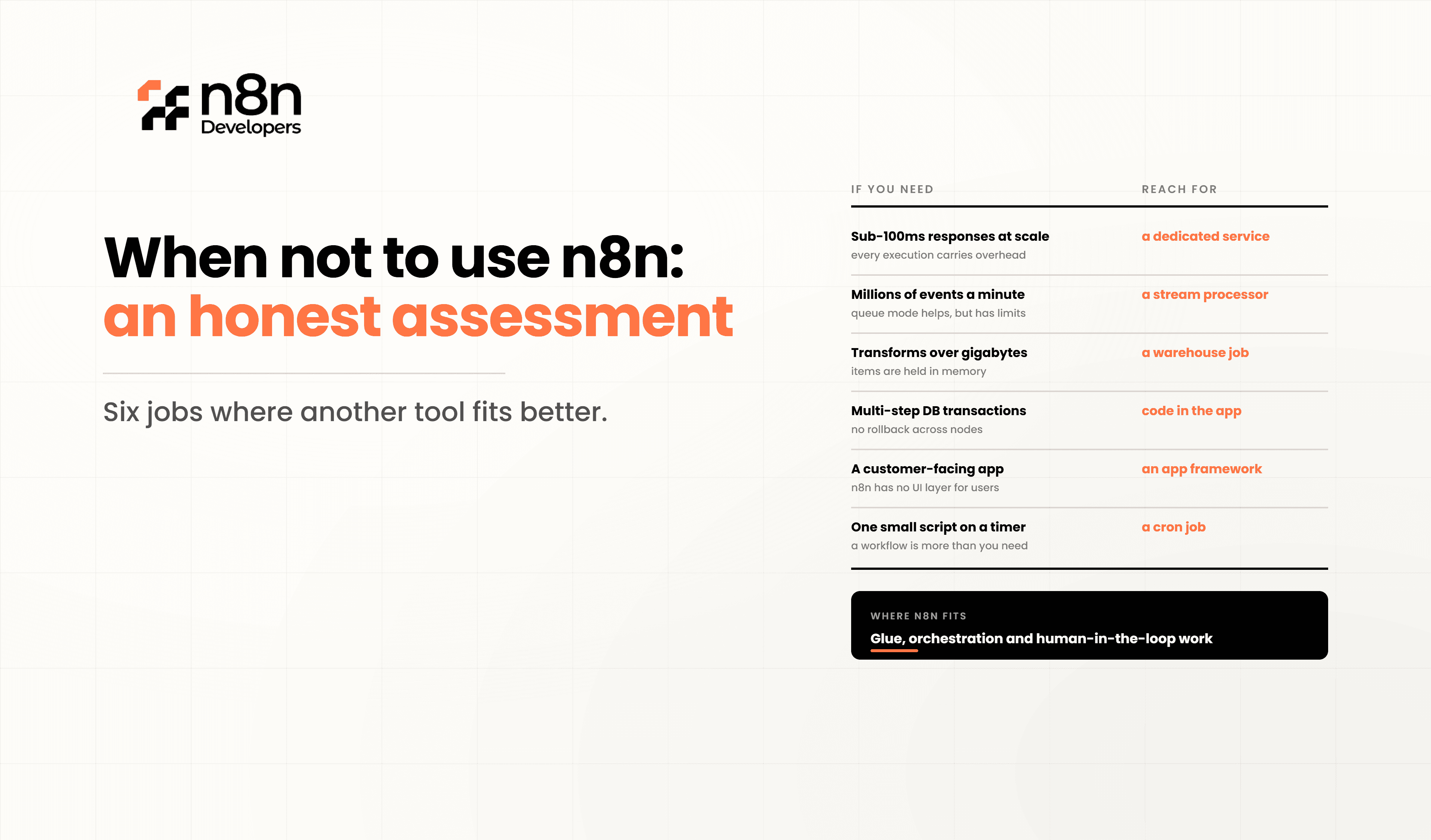
n8n runs workflows step by step. Each node adds processing time, and a workflow with many nodes, API calls, and data transformations can take seconds to complete.
That’s fine for most business automation. It’s a problem when you need responses in milliseconds.
Don’t use n8n for:
High-frequency trading or pricing engines
Real-time gaming or multiplayer backends
Fraud detection that must decide instantly at checkout
Live user-facing API endpoints with strict response time requirements
Better alternatives: Purpose-built services in Go, Node.js, Rust, or Java, or serverless functions designed for low latency.
2. When You’re Processing Massive Data Volumes
n8n holds items in memory while it processes them. With batching and queue mode, it can handle large workloads. Even so, it’s not designed to be a big data engine.
Warning signs:
Processing millions of rows in a single run
Transforming multi-gigabyte files
Workflows running out of memory or timing out
Complex joins and aggregations across huge datasets
Better alternatives: Apache Spark, dbt, Airflow, or warehouse-native SQL transformations in BigQuery or Snowflake. n8n can still trigger and monitor these jobs, but the heavy processing should happen elsewhere.
3. When You’re Handling High-Volume Event Streams
If your system needs to process tens of thousands of events per second, such as IoT sensor data, clickstreams, or application logs, n8n isn’t the right foundation.
Every execution in n8n is tracked and stored, which adds overhead at extreme volumes. Even with execution data pruning, a workflow engine isn’t a streaming platform.
Better alternatives: Apache Kafka, AWS Kinesis, Google Pub/Sub, or dedicated stream processors like Apache Flink. n8n can consume summarized or filtered events downstream.
4. When the Workflow Is Your Core Product
This is one of the most important points. If the logic is the heart of your product, the thing customers pay for, it usually belongs in your own codebase.
Reasons to keep core logic in code:
Full control over testing, performance, and architecture
Standard code review and CI/CD pipelines
Easier unit and integration testing
No dependency on a workflow platform for critical product behavior
Engineers can work with familiar tools and patterns
n8n works well around your product, for onboarding emails, CRM syncs, internal alerts, and reporting. It shouldn’t usually be your product.
5. When Licensing Doesn’t Fit Your Business Model
n8n is distributed under a fair-code license, not a traditional open-source license like MIT or Apache. For most internal business use, that isn’t an issue.
It becomes important if you plan to:
Offer n8n itself as a hosted service to customers
Embed n8n inside a product you sell
White-label n8n for clients as your own platform
These uses typically require a commercial agreement with n8n. Always review the current license terms, or get legal advice, before building a commercial product on top of n8n.
Better alternatives: For embedded automation in a SaaS product, consider n8n’s commercial embed options, or tools specifically licensed for embedding.
6. When Your Team Has No Technical Capacity
n8n is low-code, not no-code. Beyond simple workflows, it rewards technical skills: understanding APIs, JSON, expressions, authentication, and debugging. Self-hosting adds server maintenance, updates, backups, and security.
n8n may not fit if:
Nobody on the team is comfortable with APIs or JSON
You want zero infrastructure responsibility
Your automations are simple and few in number
You need non-technical staff to build everything themselves
Better alternatives: Zapier or Make offer simpler interfaces for basic automations. n8n Cloud also removes hosting work, but some technical comfort still helps.
7. When You Only Need One Simple Automation
If your entire automation need is “when a form is submitted, send an email,” n8n may be more than you need. Setting up and maintaining a self-hosted instance for one or two basic workflows rarely pays off.
Better alternatives:
Built-in automation features inside your existing tools (many CRMs, form builders, and help desks have them)
Zapier or Make free tiers for occasional, simple tasks
n8n Cloud if you expect your needs to grow
8. When You Need Long-Running, Complex Stateful Processes
n8n supports waits, webhooks, and resumable workflows. Processes that run for weeks or months with complex state, compensation logic, and guaranteed exactly-once execution are a different category, though.
Examples:
Multi-month loan or insurance approval processes
Distributed transactions that must roll back across systems
Business processes requiring formal BPMN modeling and audit
Better alternatives: Durable workflow engines like Temporal, or business process management platforms like Camunda.
9. When Strict Software Engineering Practices Are Required
Engineering teams used to Git, pull requests, automated tests, and code review may find visual workflows harder to manage. Workflows are stored as JSON, which can be version-controlled. However, diffs are harder to read than code, and automated testing is more limited than in a typical codebase.
n8n offers source control and environment features, but some are only available on higher-tier plans.
Consider alternatives if:
Every change must pass automated test suites
Code review of every line is mandatory
You need complex branching, merging, and release workflows
Better alternatives: Custom services, serverless functions, or code-first orchestration tools like Airflow, Prefect, or Temporal.
10. When Compliance Needs Exceed Your Capacity
n8n can support strict compliance environments, especially when self-hosted. But self-hosting puts responsibility for security, patching, encryption, access control, and audit logging on your team.
Be careful if:
You handle highly regulated data such as healthcare, payments, or government records
You lack staff to maintain and audit self-hosted infrastructure
Your auditors require specific certifications or controls you can’t document
In these cases, either invest properly in secure self-hosting, or choose a managed platform whose compliance certifications match your requirements.
Quick Decision Guide
Situation | Use n8n? | Consider Instead |
|---|---|---|
Connecting SaaS apps and APIs | ✅ Yes | — |
AI agents connected to business systems | ✅ Yes | — |
Mid-sized ETL and data syncs | ✅ Yes | — |
Millisecond-latency APIs | ❌ No | Custom services, serverless |
Millions of rows per run | ❌ No | Spark, dbt, warehouse SQL |
High-volume event streams | ❌ No | Kafka, Kinesis, Flink |
Your core product logic | ⚠️ Usually not |
The Hybrid Approach: n8n Plus Other Tools
In practice, the best architectures rarely use one tool for everything. Many successful teams use n8n as the glue layer while other systems handle specialized work.
Core Product (Custom Code) │ ▼ Events / Webhooks │ ▼ n8n (Orchestration & Integrations) │ ├── CRM & Marketing Tools ├── Data Warehouse (dbt / SQL transforms) ├── AI Services └── Team Notifications
In this setup:
Your product handles core logic and real-time performance
Data platforms handle heavy processing
n8n connects everything and automates business processes
This plays to n8n’s strengths and avoids its weaknesses.
Signs You’ve Outgrown n8n for a Specific Workflow
Watch for these signals:
Workflows regularly run out of memory or time out
Code nodes contain hundreds of lines of business logic
A single workflow has grown past 50–100 nodes and is hard to follow
Execution times keep rising as volume grows
Engineers avoid touching certain workflows because they’re too fragile
When you see these signs, it doesn’t always mean leaving n8n. Often it means moving one part of the logic into a dedicated service while n8n continues to orchestrate.
Why Businesses Choose Professional n8n Developers
Choosing the right tool is as important as building the workflow. Experienced developers know where n8n excels and where it struggles. They can design architectures that combine n8n with the right supporting tools. Many businesses Hire n8n Developers for honest technical guidance before committing to an automation strategy.
Why Choose N8n Developers?
N8n Developers provides Information Technology services and experienced developers who build automation that fits your business, not just the tool. Our team helps you:
Assess whether n8n is the right fit for your project
Design hybrid architectures with n8n and other platforms
Move heavy logic out of overloaded workflows
Optimize and scale existing n8n deployments
Build secure, production-ready automation
We’ll always give you an honest recommendation, even when it means using a different tool.
Conclusion
n8n is an outstanding platform for integrations, business automation, and AI workflows. It isn’t built for millisecond latency, massive data processing, high-volume event streaming, or serving as your core product logic. Knowing when not to use n8n helps you avoid costly rebuilds and choose the right architecture from the start.
The smartest teams use n8n where it shines and pair it with specialized tools where it doesn’t. That balance creates automation that’s fast, reliable, and built to last.
Not sure whether n8n is right for your project? Hire n8n Developers today for an honest assessment and an automation strategy built around your real needs.
Frequently Asked Questions
Avoid n8n for real-time low-latency systems, massive data processing, high-volume event streams, and core product logic.
Not for very large volumes. Use tools like Spark, dbt, or warehouse SQL, and let n8n orchestrate them.
These uses usually require a commercial agreement with n8n. Review the current license before building.
For technical teams needing flexibility and self-hosting, often yes. For simple automations with no technical staff, Zapier may be easier.
Experienced developers give honest advice on tool fit and design architectures that scale reliably.